
Composite vehicle armor systems are the solution for the full range of military, commercial and public safety applications.
Laminates made with S2 Glass fiber deliver a unique balance of mechanical properties. Proven in over 30 years of demanding military applications, these solutions provide exceptionally high
mechanical properties—including tensile, compression, impact, stiffness, fatigue and other beneficial structural characteristics.
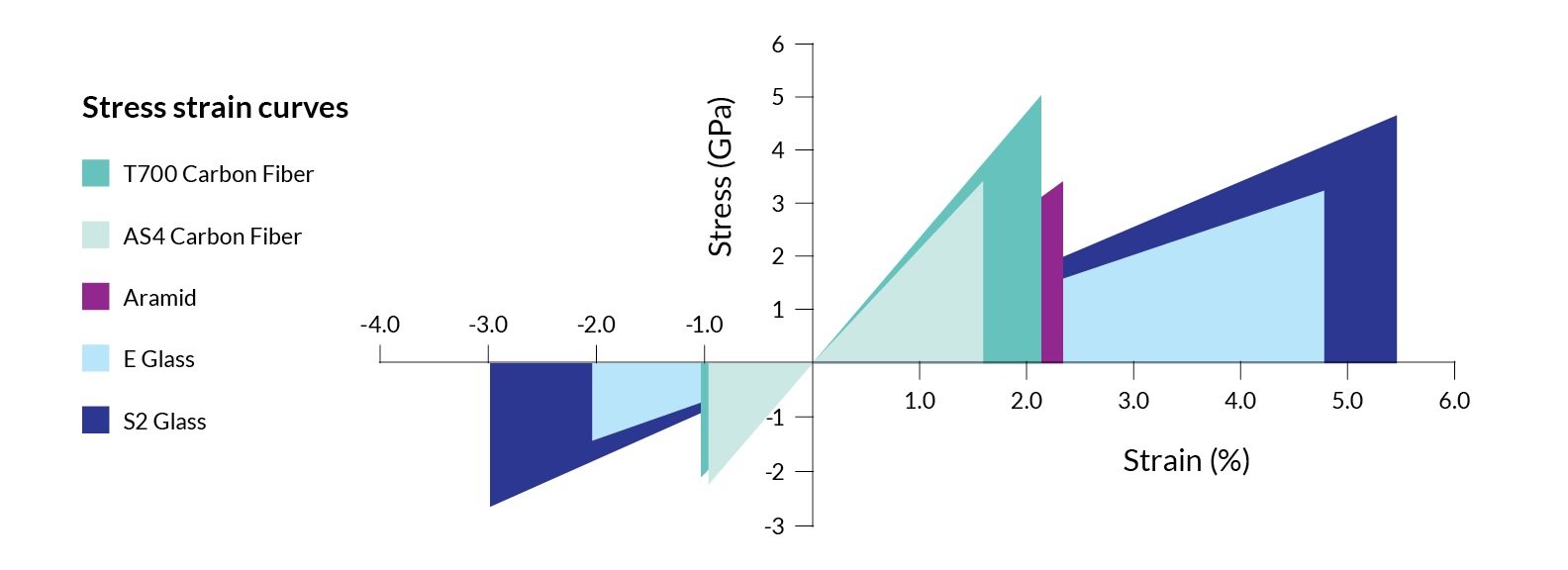
The very high tensile properties of S2 Glass fiber, when combined with an impressive strain-to-failure of 5.6%, provide laminates with exceedingly high impact resistance. Elevated tensile properties are delivered in combination with very high compression properties, enabling
this impact-resistant material to be structurally lightweight and ballistic-resistant for unmatched performance. (See diagram below.) Numerous innovative developments have been derived
from the unique balance of S2 Glass fiber properties for leveraging in structural- and ballistic-optimized armor systems.
This flexibility to customize laminate system performance facilitates innovative designs that provide game-changing lighter weight protective solutions. Each combination offers specific benefits to meet system requirements.
Ballistic-optimized parasitic armor applications
For S2 Glass armor applications where lightweight ballistic performance is critical and load carrying demands less important, systems can be designed that maximize ballistic efficiency. These parasitic systems are typically mounted behind metal structural armor. Baseline S2 Glass armor systems employ a heavy fabric with polyester, phenolic or vinyl ester resins in very high fiber content laminates. The polyester systems are easier to fabricate and less expensive. Phenolics provide low flammability, low smoke generation and a great balance of superior ballistic resistance while still delivering significant structural capabilities. Vinyl ester systems can improve mechanical properties and weatherability while still providing ease of fabrication and good ballistic performance.
The most widely used system is the S2 Glass fiber reinforced phenolic combination specified in MIL-DTL-64154B Class A—often referred to commercially as HJ1.
- MRAP Patrol Vehicles – Structurally supports the metal hull to mitigate blast, prevent penetration, and diminish spall.
- Tracked Fighting Vehicles – HJ1 spall liner behind the structural hull prevents penetration and mitigates spall inside the vehicle.
- Wheeled Fighting Vehicles – HJ1 liner diminishes spall and, when used in blast-resistant floor designs, suppresses spall and enhances blast mitigation.
All these ballistic-optimized systems provide great protection, but unlike other high-performance parasitic composite armor systems, the S2 Glass fiber systems still possess superior residual structural properties that translate into outstanding mounting ability with fewer attachments. They can also be mounted on vehicle ceilings without sagging, on vehicle floors providing superior wear and moisture resistance, or in exceptionally hot/wet environments such as engine compartments—all with no effect on the laminate or its performance. Finally, the S2 Glass armor systems are always thinner for the same ballistic protection, providing a lower space requirement than competitive armor systems.
Non-spalling high-strength structural armor applications
High-performance S2 Glass armor technology allows for the design of lighter weight fully structurally capable composite armor systems to replace heavy metal primary structure. On average, a structural S2 Glass laminate system can permit composite-hull combat vehicles to be half the weight of comparable steel-hull equipment and 30% lighter than comparable aluminum-hull vehicles.
Using a system approach to address new program requirements, AGY can recommend efficient, integrated solutions to complex design challenges. AGY can assist in the optimization of materials, the required manufacturing processes, and skilled contractors able to deliver these extraordinary components.
S2 Glass structural armor systems are capable of replacing metal hulls and providing dramatically lower-weight vehicle systems.
- UK MoD “Snatch” Vehicles – Innovative ballistic- and blast-resistant vehicle that leverages S2 Glass structural armor load-bearing capability, as well as blast and ballistic resistance. S2 Glass components include doors, walls, floor, and entire rear enclosures.
- UK MoD Foxhound Vehicles – S2 Glass structural armor provides the complete crew pod with integrated blast-resistant V-hull for this groundbreaking 4×4 MRAP vehicle.
S2 Glass armor systems optimized for structural load-bearing capability can be used to replace metallic hull and hull substructures for dramatically lighter weight solutions. These systems maximize structural performance and still maintain good ballistic efficiency, while eliminating any requirement for add-on spall liner systems. These composite systems have higher resin content to maximize laminate strengths and typically employ epoxy resins where exceptionally high structural properties are required. Phenolic-based systems have also been designed and deployed for structural laminates while certain vinyl ester systems provide near comparable performance to epoxy and phenolic with easier fabrication and storage. These systems have been designed and deployed to replace heavy metal hatches, ramps, turrets, floor, roof, and full hull applications. These structural solutions are also ideal as a thin, light, and space-efficient backing for ceramic-faced armor systems where mounting requirements and multi-hit capability are critical.